Here’s my income share portfolio I now manage in August 2026 with what’s in it, what it earns, and where I think the weak spots are. I’ve put everything in dollars rather than percentages wherever I can.
The overview
I have eleven investments worth roughly $602,000 in total. Between them they pay about $4,100 a month, which comes to just under $50,000 a year. Every single one pays monthly, so the income is fairly steady rather than lumpy.
I built this for income, not for growth. Nothing in here is meant to double. The job is to produce a reliable monthly amount without us ever having to sell something to raise cash. Roughly $2 in every $5 is invested in shares. The other $3 lends money out and collects interest. That mix is deliberate, and I explain why further down.
Of the $4,100 a month, about $3,683 arrives as actual cash in the account. The remaining $417 or so comes back later as a tax refund, because tax was already paid on part of the income before it reached us. It’s real money, it just arrives once a year instead of monthly.
Income Portfolio at a glance
The last column is the easiest way to compare them. It’s what each investment pays per year for every $100 we have in it. Across the whole portfolio that number is about $8.20.
| Investment | What it does | Value | Pays monthly | Per $100 a year |
|---|---|---|---|---|
| Whitefield Income | Owns Australian shares | $174,313 | $1,125 | $7.75 |
| Gryphon Capital | Buys bundled home loans | $113,636 | $759 | $8.00 |
| Metrics Master Income | Lends to Australian businesses | $95,910 | $680 | $8.50 |
| Plato Income Maximiser | Owns Australian shares | $41,970 | $236 | $6.75 |
| KKR Credit Income | Lends to businesses overseas | $38,131 | $300 | $9.40 |
| 360 Capital Mortgage | Lends against commercial property | $34,369 | $297 | $10.35 |
| Qualitas RE Income | Lends against commercial property | $32,453 | $228 | $8.45 |
| MA Credit Income | Lends to Australian businesses | $23,794 | $175 | $8.85 |
| WAM Income Maximiser | Owns Australian shares | $22,462 | $123 | $6.55 |
| VanEck Private Credit | Owns overseas lending companies | $15,450 | $143 | $11.05 |
| Betashares Enhanced Credit | Borrows to buy bonds | $10,000 | $63 | $7.60 |
| Total | $602,488 | $4,128 | $8.20 |
The two halves, and why I keep both
| Owns shares | Lends money | |
|---|---|---|
| Value | $238,745 | $363,743 |
| Pays monthly | $1,483 | $2,645 |
| Number of holdings | 3 | 8 |
| Tax refund attached | Yes | No |
| Moves with interest rates | No | Yes |
The lending side pays more on paper. That’s the obvious appeal. But its payments float with the Reserve Bank’s cash rate, so if rates get cut, our income drifts down without anything actually going wrong at any of these funds.
The share side pays less on paper but comes with the tax refund, which closes most of the gap once you count it. It also doesn’t shrink when rates fall. That’s the reason I hold both rather than chasing the higher headline number and putting everything into lending. I’m buying a second, unrelated source of income, not just a slightly different flavour of the same thing.
When the money arrives
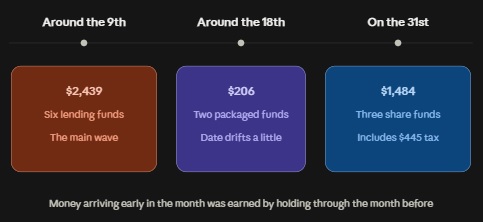
Every one of the eleven pays monthly, but not on the same day. It comes in three waves.
| Wave | Roughly when | Amount |
|---|---|---|
| The big one | 8th to 10th | $2,439 |
| The small one | Around the 18th | $206 |
| The share funds | On the 31st | $1,484 |
Portfolio Breakdown
Whitefield Income, $174,313, pays me $1,125 a month. This is the largest thing I own and my single biggest source of income. It holds a spread of Australian companies and passes the dividends through. Of the $7.75 it pays per $100 each year, only about $5.40 arrives as cash and the rest is the tax refund. That’s exactly why I hold it instead of putting the money into a higher-paying lender: once the refund is counted it competes well, and unlike the lenders it doesn’t shrink if rates get cut.
I want to be direct about the risk here. Nearly $3 of every $10 I manage sits in this one fund, and it makes up about three quarters of everything on the share side. It got that big throug separate purchases rather than one deliberate decision, which is how concentration usually happens. It’s the first thing I’d address if I were rebalancing.
Plato Income Maximiser, $41,970, pays me $236 a month. A second Australian share fund with a different manager, built specifically for people who benefit from the tax refund. At $6.75 per $100 it’s the lowest payer I own. It normally trades above the value of the shares inside it, which has been true for years and isn’t a warning sign by itself.
WAM Income Maximiser, $22,462, pays me $123 a month. The newest and smallest of my three share funds. I built most of this position recently and it’s currently worth about $250 less than I paid. At this size that’s noise, not a problem. It pays $6.55 per $100.
The lenders
Gryphon Capital, $113,636, pays me $759 a month. My second-largest holding. It buys bundles of Australian home loans and collects the repayments, which makes it about as unexciting as an investment gets. That’s the appeal. $8 per $100, and I have no plans to reduce it.
Metrics Master Income, $95,910, pays me $680 a month. Lends directly to Australian businesses and is the largest fund of its type on the market here, so I can buy or sell it easily. At $8.50 per $100 it pays a bit better than Gryphon for a similar-sized position, which is worth remembering next time I have money to put somewhere.
MA Credit Income, $23,794, pays me $175 a month. Another business lender, smaller and newer than Metrics, paying $8.85 per $100.
KKR Credit Income, $38,131, pays me $300 a month. Lends to businesses overseas, run by a large American firm, paying $9.40 per $100. Two things to flag. The income comes from abroad, so there’s no Australian tax refund attached. And I have an unresolved arithmetic question about what I actually paid for this holding that I need to check against the original paperwork. It has no effect on the income, but it would matter for tax if I ever sold.
360 Capital Mortgage, $34,369, pays me $297 a month. Lends against commercial property and pays $10.35 per $100, the best rate among my direct lenders. That rate is high for a reason. It’s a small fund with a concentrated set of loans, so a single borrower in trouble hurts more here than it would in a large diversified fund. I keep it deliberately small, and right now it’s a little larger than I want.
Qualitas Real Estate Income, $32,453, pays me $228 a month. Also lends against commercial property, but bigger and more spread out than 360 Capital, at $8.45 per $100. I’m comfortable with it where it is.
The two packaged funds
VanEck Global Listed Private Credit, $15,450, pays me $143 a month. Rather than lending directly, this buys shares in overseas lending companies. At $11.05 per $100 it’s my highest payer, and it’s my only real exposure outside Australia. The payment was recently cut by 5%, costing about $90 a year. One cut is ordinary. A second would make me want an explanation.
Betashares Enhanced Credit Income, $10,000, pays me $63 a month. My newest purchase and the one I’m least settled on. It borrows money to buy bonds, which lifts the income but also magnifies any loss if bond prices fall. It charges roughly four times the management fee of a typical fund in this portfolio, and it only launched in late 2025, so there’s almost no track record to judge.
My concern is straightforward. Even with the borrowing, it pays $7.60 per $100, which is less than every other lender I hold. I’m taking on extra risk and a higher fee for below-average income. At $10,000 it can’t do real damage, but I wouldn’t grow it without a better reason than I currently have.
What I’m watching
| Item | Why it’s on my list |
|---|---|
| Whitefield’s size | Nearly 30% of everything, built up by accumulation rather than decision |
| 360 Capital’s size | Larger than I want given how concentrated its loan book is |
| The Betashares position | Extra risk and a high fee for below-average income |
| VanEck’s next payment | One cut is fine, two would be a pattern |
| Interest rates | Just under 60% of the portfolio floats with the cash rate |
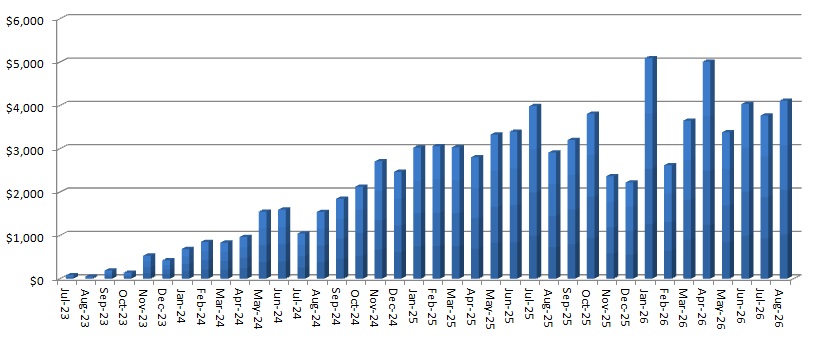
Dividend Income Progression
Here’s my income portfolio journey since July 2023 in a snapshot.